AI Is Driving Data Center Growth in Sweden—and a New Demand for Energy Infrastructure
Sweden is attracting billions in data center investment as it pursues its ambition of becoming a top-ten AI nation. But building data centers is only half the equation. Powering them reliably, in Nordic conditions, is the other.
This article in brief
- Everything you do digitally that isn’t stored on your own device runs through a data center—physical buildings, consuming real electricity.
- AI is changing what those facilities need: a single AI query can use up to ten times more energy than a standard search, and AI server racks draw up to 120 kW compared to 15 kW for standard ones.
- Sweden is positioning itself as a top-ten AI nation, with tens of billions of kronor flowing into data center capacity—Microsoft alone committed 33.7 billion SEK.
- This growth creates demand for power that is not just sufficient, but reliable, responsive, and able to handle rapid fluctuations.
- Battery energy storage systems (BESS) address these challenges by managing peaks, stabilizing power quality, and providing millisecond-level backup.
- Sweden’s cold climate attracts data centers but demands BESS solutions specifically engineered for Nordic conditions.
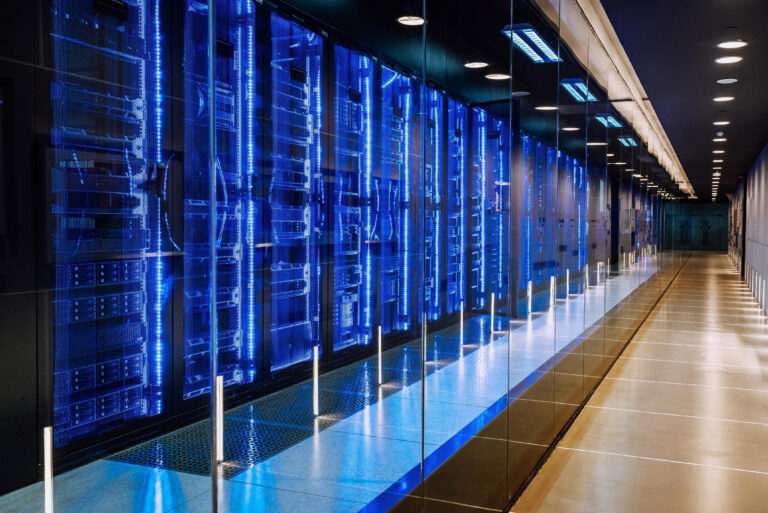
A data center is essentially a large facility filled with servers—powerful computers that store, process, and deliver data. When a company says their service is ”in the cloud,” what they really mean is that it’s running on servers in a data center somewhere. Everything you do digitally, whether on the internet or not, that isn’t stored locally on your own device, lives in physical buildings, on physical hardware, consuming electricity.
AI queries use 10x more energy than a Google search
A single AI query uses roughly ten times more energy than a standard Google search. Every time you ask an AI model a question, a cluster of processors spins up, draws power, generates heat, and delivers an answer. Multiply that by millions of queries per hour, and you begin to understand why AI is fundamentally changing what data centers need from their energy supply.
To keep up with the surging demand for AI from both businesses and consumers, data centers need more powerful hardware. The processors that drive AI workloads are significantly more power-hungry; a single AI-optimized server rack can draw 120 kW or more, compared to around 15 kW for a standard one.
This demand is driving data center investment worldwide, and Sweden is one of the countries attracting it.
Sweden to be a top-ten AI nation globally
In February 2026, the Swedish government published a national AI strategy with the ambition of making Sweden a top-ten AI nation globally. Major technology companies have committed tens of billions of kronor to data center capacity in Sweden, drawn by the country’s cold climate, high share of renewable energy, and strong digital infrastructure. Microsoft alone announced 33.7 billion SEK in Swedish data center and AI infrastructure investment—the company’s largest ever in the country.
The result is a rapidly growing concentration of energy-intensive facilities, all requiring large volumes of reliable, high-quality power. However, delivering that power is not just a matter of volume. It requires speed, consistency, and the ability to respond to rapid fluctuations in demand. AI processors can jump from 25% to 95% utilization in an instant when a training run begins, creating power swings that traditional infrastructure was not designed to handle. And the stakes are high: according to FlexGen, 70% of all data center outages cost businesses $100,000 or more.
The role of BESS
Battery energy storage systems (BESS) address several of these challenges. Not as a replacement for other power sources, but as infrastructure that makes the overall energy system work better.
BESS are large-scale battery installations that store energy and release it precisely when and where it’s needed, acting as a buffer between supply and demand. In the context of data centers, that means BESS can absorb sudden spikes in demand, stabilize voltage and frequency when loads fluctuate, provide backup power that responds in milliseconds rather than seconds, and bridge the gap between when a facility is ready and when its full power supply is in place.
The case for BESS is clear. What’s less obvious is what it takes to deploy one that actually performs.
A cold climate is good for cooling—but tough on batteries
Sweden’s cold climate is one of the reasons data centers are being built here; it reduces cooling costs significantly. But that same climate puts specific demands on the energy infrastructure that supports them.
Battery systems need to perform reliably across Nordic temperature ranges, through harsh winters and varying conditions. That requires purpose-built engineering: thermal management, enclosure design, and control systems adapted for the environment they actually operate in.
This is where Monsson Energy Nordics operates. We design, build, and operate battery energy storage systems purpose-built for the Nordic climate, with European-manufactured components. The challenges the data center industry faces around power reliability, scalability, and quality are challenges we work with every day.
AI is reshaping the energy demands of one of the world’s fastest-growing infrastructure sectors. Sweden has set its sights on becoming a top-ten AI nation, and billions of kronor are being invested in data center capacity across the country. Alongside this push comes the question of how to deliver power that is not just sufficient, but reliable, responsive, and built for Nordic conditions.
Monsson Energy Nordics is working to be part of that answer.
Sources and further reading
IEA, “Energy and AI” (2025) https://www.iea.org/reports/energy-and-ai/energy-demand-from-ai
IEA, “AI Is Set to Drive Surging Electricity Demand from Data Centres” (2025) https://www.iea.org/news/ai-is-set-to-drive-surging-electricity-demand-from-data-centres-while-offering-the-potential-to-transform-how-the-energy-sector-works
Carbon Brief, “AI: Five Charts That Put Data-Centre Energy Use into Context” (2025) https://www.carbonbrief.org/ai-five-charts-that-put-data-centre-energy-use-and-emissions-into-context/
UNRIC, “Artificial Intelligence: How Much Energy Does AI Use?” (2025) https://unric.org/en/artificial-intelligence-how-much-energy-does-ai-use/
Dell’Oro Group via CoreSite, “AI and the Data Center: Driving Greater Power Density” (2024) https://www.coresite.com/blog/ai-and-the-data-center-driving-greater-power-density
Goldman Sachs, “Rising Power Density Disrupts AI Infrastructure” (2025) https://www.goldmansachs.com/insights/articles/rising-power-density-disrupts-ai-infrastructure
Regeringen.se, “Sveriges AI-strategi på fem minuter” (2026) https://www.regeringen.se/artiklar/2026/02/sveriges-ai-strategi-pa-fem-minuter/
Microsoft / Data Center Dynamics, “Microsoft to Deploy 20,000 GPUs in Sweden” (2024) https://www.datacenterdynamics.com/en/news/microsoft-to-deploy-20000-gpus-in-sweden/
FlexGen, “Expert Q&A: Why Battery Energy Storage Is the Future of Data Center UPS Solutions” https://www.flexgen.com/resources/blog/expert-qa-why-battery-energy-storage-future-data-center-ups-solutions